What We Wish We Knew Before First Buying Additive?
When I receive inquiry emails from new buyers, I can immediately tell who is about to make a costly mistake. They send me a list of technical parameters copied from somewhere, but they never ask the one question that actually matters: "How will I know if this batch works the same as the last one?"
The biggest trap in first-time additive buying is not choosing the wrong purity level. It is not understanding which quality variations will ruin your product and which ones you will never notice. When you focus on the wrong specifications, you waste money on tests that do not protect you and skip the checks that would have caught the problem before production.

Most purchasing mistakes happen because buyers treat all peptide additives the same way. A pharmaceutical manufacturer needs one thing. A medical beauty brand needs something different. A supplement producer has completely different risks. But everyone asks for the same documents and compares the same price per gram.
Why does everyone request 98% purity when their formulation works fine at 95%?
I had a supplement manufacturer contact me last month. He insisted on 98% minimum purity for his weight management capsules. I asked him a simple question: "What happens if the purity is 96.5% but the impurity profile stays identical?" He paused. He did not know.
Purity percentage alone tells you almost nothing about whether an additive will work in your product. What matters is which specific impurities exist and whether they interfere with your formulation stability or regulatory requirements. A 96% pure batch with consistent impurity types performs more reliably than a 98.5% batch where the remaining 1.5% contains different substances every time.
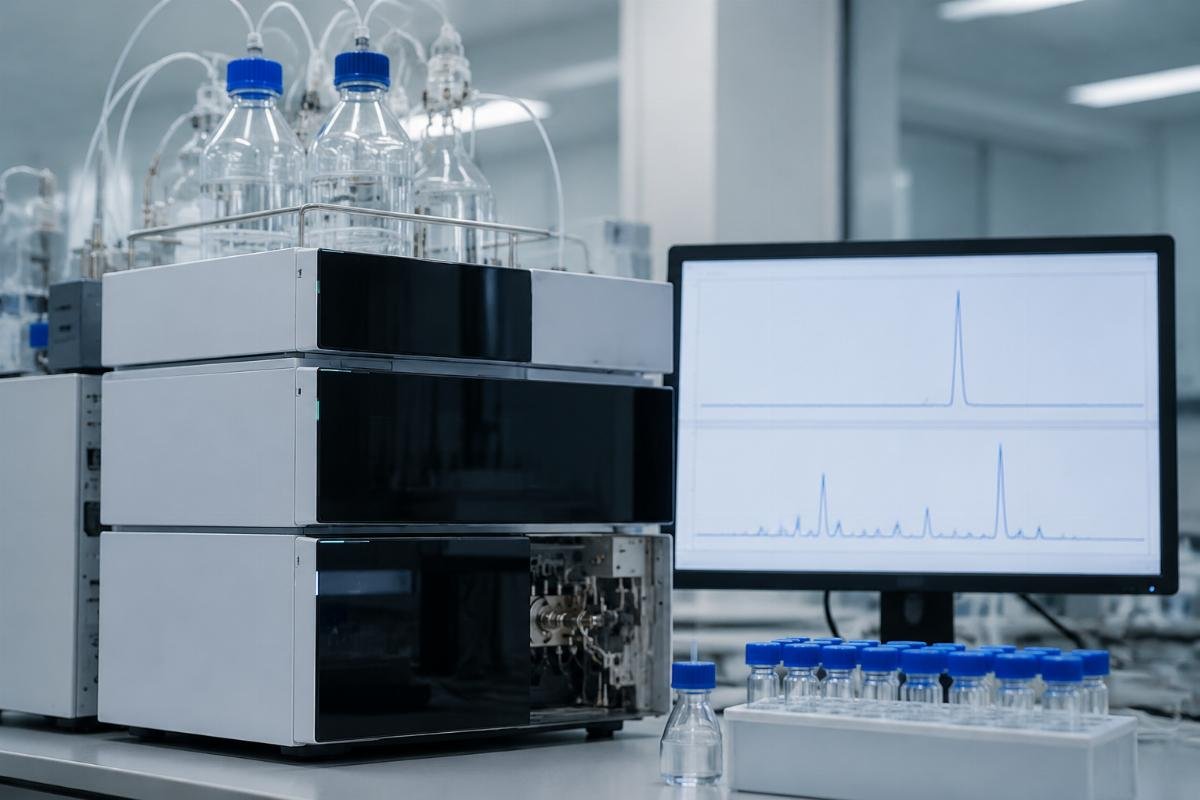
Different applications have completely different impurity tolerance. Pharmaceutical manufacturers cannot accept any unidentified peaks above 0.1% in their HPLC analysis[^1]. They need full impurity characterization because regulatory agencies will audit every synthesis step. Medical beauty products have more flexibility on impurity types but stricter requirements on endotoxin levels because the product goes directly into skin[^2]. Supplement producers focus on heavy metal content and microbial limits more than trace peptide fragments.
Here is what actually matters for each application:
| Application Type | Critical Quality Factor | Why It Matters | What To Check |
|---|---|---|---|
| Pharmaceutical Production | Batch-to-batch impurity consistency | Regulatory agencies audit process validation | Request HPLC overlays from 3 consecutive batches |
| Medical Beauty Formulation | Endotoxin level control | Direct skin contact increases reaction risk | Verify LAL test results below 0.5 EU/mg[^3] |
| Supplement Manufacturing | Heavy metal contamination | Long-term consumption safety requirements | Check ICP-MS data[^4] for lead, mercury, cadmium |
| Lab Research Use | Known structure confirmation | Experimental reproducibility depends on compound identity | Confirm MS data matches theoretical molecular weight |
I once worked with a medical beauty distributor who rejected a batch because it was 97.8% pure instead of 98%. But he never checked the endotoxin level. That batch would have passed his purity requirement but failed his actual safety need. He wasted three weeks and paid storage fees because he focused on the wrong specification.
The question you should ask is not "what purity do I need?" The real question is "which impurities will cause problems in my specific product?" A pharmaceutical buyer needs to know if the synthesis byproducts are characterized. A beauty brand needs to know if bacterial fragments are present. A supplement maker needs to know if heavy metals are controlled. These are completely different questions that the same purity number cannot answer.
Do you actually know what a COA proves and what it does not?
Last week someone sent me an inquiry asking for COA, MS, HPLC, and EP certificate. I replied: "Which of these documents do you legally need, and which are you requesting because other buyers ask for them?" He admitted he was not sure.
A Certificate of Analysis tells you what the supplier tested in one specific batch. It does not prove the supplier made the product. It does not guarantee the next batch will match. It does not confirm the test methods are appropriate for your application. Most first-time buyers collect certificates without understanding which documents actually reduce their procurement risk.

I see this pattern constantly. Buyers request a full set of documents, receive them, and assume they are protected. But they never verify if the test methods match their compliance requirements. A COA showing 98.2% purity is worthless if your regulatory agency requires a different HPLC method than the one the supplier used. A mass spectrometry report confirming molecular weight does not tell you about process-related impurities that share the same mass.
Here is what each document actually proves and what it cannot tell you:
Certificate of Analysis proves one batch met the listed specifications on the test date. It does not prove batch consistency. It does not prove the supplier manufactured it. It does not prove the test method is appropriate. You need to check if the test date is recent, if the batch number matches your order, and if the test methods align with your quality standards.
Mass Spectrometry data confirms molecular structure matches the target compound[^5]. It does not quantify purity. It does not identify all impurities. It does not prove batch stability. You need to verify the molecular weight matches theoretical calculations and check for unexpected peaks that indicate structural variants.
HPLC chromatogram shows purity percentage and impurity peaks[^6]. It does not identify what those impurities are. It does not prove the method can separate all possible contaminants. It does not indicate if impurities are toxic or just inert. You need to compare peak retention times across batches and verify the method resolution is sufficient for your needs.
Pharmacopoeia certificates like EP or USP show the supplier knows regulatory standards[^7]. They do not prove every batch meets those standards. They do not replace batch-specific testing. They do not confirm the product is suitable for your specific use case. You need to verify the certificate covers the exact compound you are buying and check if your market accepts that standard.
The documents that actually matter depend on your compliance situation. Pharmaceutical manufacturers need full validation data and stability studies. Medical beauty brands need microbiological test results and preservative efficacy data. Supplement producers need heavy metal screening and shelf-life testing. But most buyers ask for the same generic document set without connecting it to their actual risk.
I had a pharmaceutical buyer who requested everything except the one document he legally needed: a Drug Master File[^8] reference. He collected certificates that looked impressive but did not satisfy his regulatory requirement. We had to restart the qualification process because he did not know which documents his auditors would actually check.
The question is not "did the supplier send certificates?" The question is "do these specific test results address my specific compliance gaps?" If you cannot explain why you need each document, you are probably requesting the wrong things.
How do you verify a supplier actually manufactures instead of just resells?
I can spot a trading company pretending to be a manufacturer in the first conversation. They talk about certificates and prices. Real manufacturers talk about synthesis conditions and batch scheduling.
The difference between a manufacturer and an intermediary is not who has better certificates. It is who can explain why batch parameters vary and show you production evidence that matches their claimed capacity. Intermediaries can show you documents. Only manufacturers can show you process knowledge and capacity timelines that prove they control the source.

Most buyers ask "do you have GMP certification[^9]?" But GMP certificates can be borrowed, shared, or outdated. The questions that reveal real manufacturing capability are completely different. Can they explain lead time based on synthesis cycle? Can they describe how they handle batch failures? Can they show capacity allocation that proves they are not just ordering from someone else?
Here are the verification questions that actually work:
Ask about batch size flexibility and minimum order quantity. Real manufacturers have fixed capacity constraints based on equipment. If a supplier claims they can produce any quantity from 10 grams to 100 kilograms with the same lead time, they are probably reselling. We can produce 5-10 kilogram batches in one synthesis run. Smaller orders require partial batch allocation. Larger orders need multiple runs with extended scheduling. That is how real production works.
Ask about synthesis timeline and intermediate steps. Manufacturers know the process duration because they control it. We need 7-10 days for solid-phase synthesis[^10], 2-3 days for purification, and 3-5 days for QC testing before shipping. Intermediaries give vague answers like "depends on stock" because they wait for someone else to produce.
Ask what happens when QC fails and how they handle re-purification. This question separates manufacturers from traders immediately. We can reprocess batches if purity falls below target. We know which purification adjustments improve specific impurity profiles. Traders cannot answer this because they do not control the process.
Ask for production scheduling details. If you place an order today, when does synthesis start, when does purification finish, when do QC results come back? Manufacturers can show you capacity calendars. Traders give estimated shipping dates without explaining the steps in between.
Ask about raw material sourcing for key amino acids. Manufacturers know which starting materials affect yield and quality because they handle synthesis failures. We track which amino acid suppliers give better coupling efficiency. Traders do not know these details because they never see the production floor.
I remember a buyer who visited three suppliers in China. Two had impressive showrooms and certificates. The third had a smaller office but took him directly to the synthesis workshop. He chose the third one because he saw the actual purification equipment and watched technicians handle a batch. The first two never offered facility access because they did not have facilities.
The verification method is simple. Ask process questions that only someone running production would know. If they can explain batch variance, synthesis troubleshooting, and capacity constraints in specific detail, they control manufacturing. If they only talk about certificates and prices, they are probably middlemen.
Why does the cheapest quote always become the most expensive choice?
Three months ago a supplement manufacturer told me he saved 15% by choosing a cheaper supplier. Last week he contacted me again. He needs to reformulate his entire product line because the new batches do not match the original specifications. The 15% savings cost him six weeks of production delay and three reformulation cycles.
Price-per-gram comparison ignores the hidden cost that matters most: batch consistency. A supplier who cannot maintain the same impurity profile across orders forces you to revalidate formulations, adjust processing parameters, or face product quality complaints. The real cost is not the ingredient price. It is the operational disruption when specifications drift.

First-time buyers focus on unit price because it is easy to compare. They receive three quotes. They choose the lowest number. But they do not calculate the cost of inconsistency. What happens when batch five has different dissolution rates than batch one? What happens when your stability testing fails because the new supplier's impurity profile changed? What happens when your customer complaints increase because product performance varies?
The actual cost factors most buyers miss:
Reformulation labor costs more than ingredient savings. If you save $500 per kilogram but spend $5000 adjusting your formulation because the new supplier's particle size distribution is different, you lost money. I saw a medical beauty brand switch suppliers to cut costs. They spent three months reformulating their serum because the new peptide had different solubility behavior. The development team's time cost more than two years of the original supplier premium.
Batch rejection risk multiplies when consistency drops. If you have 98% batch acceptance with your current supplier and 85% acceptance with the cheaper option, you are not saving 15% on price. You are losing 13% of your production capacity to quality holds and reprocessing. A pharmaceutical manufacturer I work with calculated that one failed batch costs them $12000 in lost production time and material waste. The ingredient cost was only $800.
Customer complaint handling erases all savings. If your product works perfectly for three months and then customer returns spike because batch consistency changed, your savings disappear into refunds and brand damage. A supplement brand switched suppliers to save 20%. Six months later their return rate tripled because capsules showed inconsistent results. They spent the entire savings on customer service and reputation recovery.
Regulatory audit failures have catastrophic costs. If your cheaper supplier cannot provide adequate documentation during an audit, you risk production shutdowns and compliance violations. One pharmaceutical buyer saved $3000 per order with a new supplier. When regulatory inspectors requested batch genealogy data, the supplier could not provide it. The buyer faced a warning letter and suspended three product lines. The compliance remediation cost exceeded $200000.
The question you should ask is not "who has the lowest price?" The question is "what is the total cost of ownership including consistency risk, reformulation probability, and quality failure exposure?" I worked with a medical beauty distributor who pays 12% more for peptides from a supplier with proven batch stability. He calculated that the consistency value saves him $15000 annually in avoided reformulation work and reduced batch rejection rates.
Price becomes the deciding factor only after you confirm batch consistency, process control capability, and documentation reliability. When those factors are equal, choose lower price. When they are not equal, the cheaper supplier usually costs more in ways that do not appear in the initial quote.
Conclusion
The knowledge gap that costs first-time buyers the most is not technical expertise. It is knowing which quality signals predict the problems you will actually face versus which ones just look impressive on paper. Focus on batch consistency over single-batch purity, application-specific risks over generic certificates, and manufacturing evidence over document collections.
[^1]: "[PDF] Guidance for Industry Q3A Impurities in New Drug Substances - FDA", https://www.fda.gov/media/71727/download. International regulatory guidelines such as ICH Q3A and Q3B establish identification thresholds for impurities in pharmaceutical products, typically requiring identification of degradation products above 0.1% in drug substances. Evidence role: statistic; source type: government. Supports: the regulatory threshold for unidentified impurities in pharmaceutical manufacturing. Scope note: Specific thresholds may vary by dosage form, daily intake, and regional regulatory authority [^2]: "Bacterial Endotoxins/Pyrogens - FDA", https://www.fda.gov/inspections-compliance-enforcement-and-criminal-investigations/inspection-technical-guides/bacterial-endotoxinspyrogens. Regulatory agencies establish endotoxin limits based on route of administration, with parenteral and injectable products requiring significantly lower bacterial endotoxin levels than oral products due to direct systemic or tissue exposure bypassing natural barriers. Evidence role: mechanism; source type: government. Supports: why products with direct tissue contact require lower endotoxin limits. Scope note: Topical cosmetic products may have different standards than injectable medical devices depending on jurisdiction [^3]: "Bacterial Endotoxins/Pyrogens - FDA", https://www.fda.gov/inspections-compliance-enforcement-and-criminal-investigations/inspection-technical-guides/bacterial-endotoxinspyrogens. Pharmacopeial standards such as USP <85> establish endotoxin limits for pharmaceutical raw materials and finished products, with limits varying by route of administration and dose, commonly expressed in Endotoxin Units per unit mass or volume. Evidence role: statistic; source type: government. Supports: typical endotoxin limits for pharmaceutical ingredients. Scope note: The specific 0.5 EU/mg threshold may represent industry practice rather than a universal regulatory requirement [^4]: "A rapid ICP-MS screen for heavy metals in pharmaceutical ...", https://pubmed.ncbi.nlm.nih.gov/15193718/. Inductively coupled plasma mass spectrometry (ICP-MS) is an analytical technique that ionizes samples in high-temperature plasma and measures elemental composition with high sensitivity and specificity, making it a standard method for detecting trace levels of heavy metals and other elements in pharmaceutical and nutritional products. Evidence role: mechanism; source type: encyclopedia. Supports: how ICP-MS is used for elemental analysis. [^5]: "Development of an LC-MS/MS peptide mapping protocol for ... - PMC", https://pmc.ncbi.nlm.nih.gov/articles/PMC5830484/. Mass spectrometry measures the mass-to-charge ratio of ionized molecules, providing molecular weight information that can confirm compound identity by comparing experimental values to theoretical molecular weights, though it does not directly determine complete structural details or quantify purity. Evidence role: mechanism; source type: encyclopedia. Supports: how mass spectrometry confirms molecular identity. Scope note: MS confirms molecular weight but does not provide complete structural elucidation or distinguish between isomers with identical mass [^6]: "High-performance liquid chromatography - Wikipedia", https://en.wikipedia.org/wiki/High-performance_liquid_chromatography. High-performance liquid chromatography (HPLC) separates mixture components based on differential interactions with a stationary phase, allowing quantification of main components and detection of impurities through peak area integration, making it a standard analytical method in pharmaceutical quality control. Evidence role: mechanism; source type: encyclopedia. Supports: how HPLC is used for purity determination and impurity detection. [^7]: "The role of the pharmacopoeia in the control of pharmaceutical ...", https://pubmed.ncbi.nlm.nih.gov/1234732/. Pharmacopoeias such as the European Pharmacopoeia (EP) and United States Pharmacopeia (USP) are official compendia that establish legally recognized quality standards, test methods, and specifications for pharmaceutical ingredients and products in their respective jurisdictions. Evidence role: definition; source type: institution. Supports: the role of pharmacopoeias as official quality standards. [^8]: "Types of Drug Master Files (DMFs) - FDA", https://www.fda.gov/drugs/drug-master-files-dmfs/types-drug-master-files-dmfs. A Drug Master File (DMF) is a submission to regulatory authorities such as the FDA containing confidential detailed information about facilities, processes, or articles used in the manufacturing, processing, packaging, or storage of drug products, allowing ingredient manufacturers to support their customers' applications without disclosing proprietary information. Evidence role: definition; source type: government. Supports: the definition and regulatory purpose of Drug Master Files. [^9]: "Facts About the Current Good Manufacturing Practice (CGMP) - FDA", https://www.fda.gov/drugs/pharmaceutical-quality-resources/facts-about-current-good-manufacturing-practice-cgmp. Good Manufacturing Practice (GMP) is a system of quality assurance ensuring pharmaceutical products are consistently produced and controlled according to quality standards, with certification programs administered by regulatory authorities to verify compliance with manufacturing, testing, and documentation requirements. Evidence role: definition; source type: institution. Supports: the definition and purpose of Good Manufacturing Practice standards. [^10]: "Solid-phase peptide synthesis - PubMed", https://pubmed.ncbi.nlm.nih.gov/4307033/. Solid-phase peptide synthesis (SPPS), developed by Bruce Merrifield in the 1960s, is a method for producing peptides by sequentially coupling amino acids to a growing peptide chain attached to an insoluble resin support, enabling efficient purification between reaction steps. Evidence role: definition; source type: encyclopedia. Supports: the definition and mechanism of solid-phase peptide synthesis.